
EXECUTIVE FUNCTIONING SKILLS
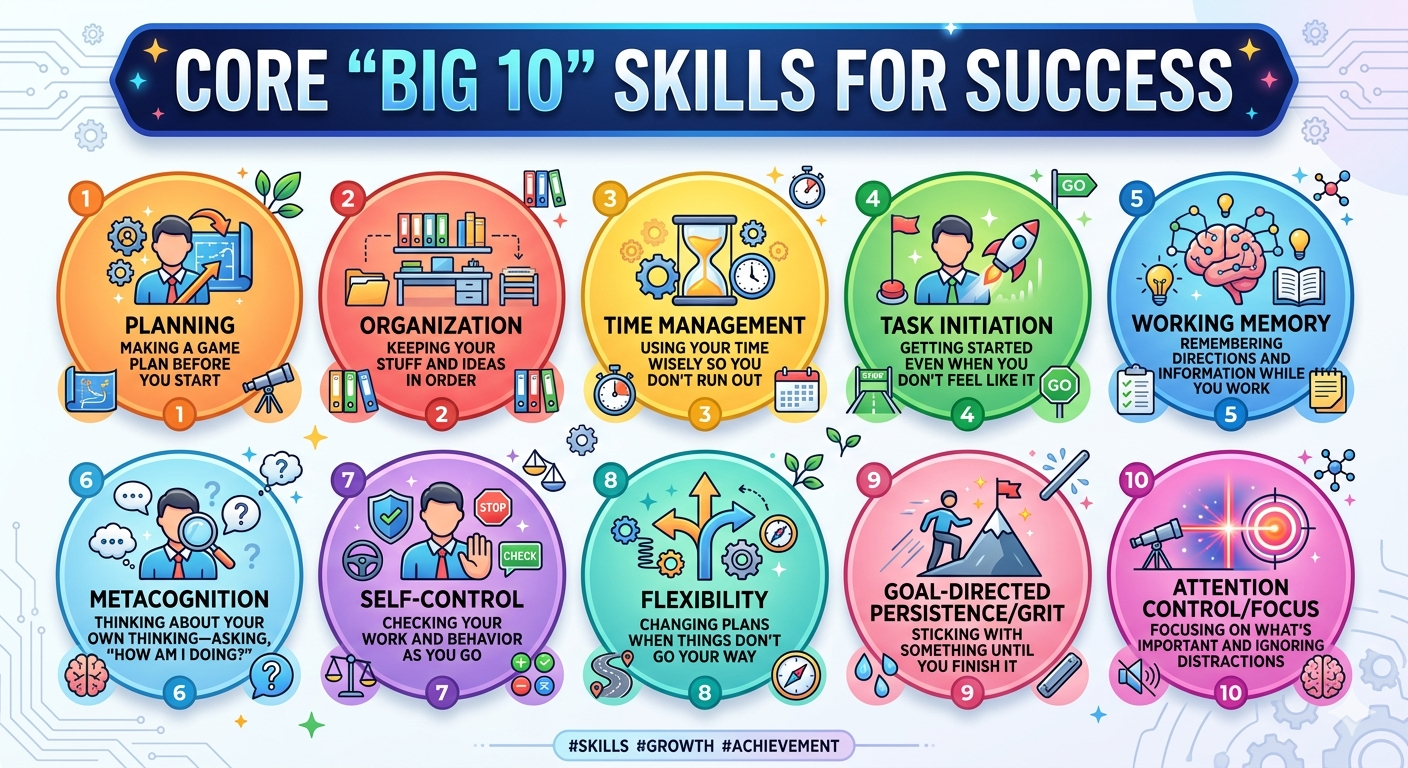
Executive functioning skills are the brain-based processes that help students to plan, focus attention, remember instructions, manage emotions, and regulate behavior in order to achieve goals.
They act like a “management system” for the brain—coordinating thinking, actions, and emotions so students can get things done effectively.
Tools for Teaching Executive Functioning Skills
EXECUTIVE FUNCTIONING SKILLS VIDEOS FOR TEACHERS
Overview of Executive Functioning Skills - Executive functioning skills are the things that successful people do on a daily basis which leads to their achievement. It includes skills such as task initiation, planning, attention, and time management.
Planning (Executive Functioning Skills) - We always expect students to have a plan, but do we always show them how to do it? What if we were more deliberate about teaching students how you plan out a long term project, or a study schedule for an upcoming test, or even their workload for the current day?
Time Management (Executive Functioning Skills) - you can plan and organize yourself all you want, but if you are unable to manage the time you are allotted, nothing is going to get done.
Metacognition (Executive Functioning Skills) - metacognition is an awareness of your own thoughts. But how do you teach students to be aware of this? You provide them structure to be able to think about their thinking.
Working Memory (Executive Functioning Skills) - in order to learn, we have to hold something in our minds at least long enough for us to apply it. Sometimes though this content is forgotten and we are unable to use it effectively, other times it enters into the long-term memory and we can use it to show understanding.
Self Control/Regulation (Executive Functioning Skills) - are you unable to keep your emotions in check? Can you not resist the urge to do something when it tempts you? Do you find yourself blurting out answers the second they pop into your head?
Ranking of Executive Functioning Skills
Strategies for Coping with Weaker EFS
Video on Working Memory Strategies
Project Contract with Focus on EFS
Overview of Executive Functioning Skills
Role Playing Cards (Elementary) Self Control
Role Playing Cards (Middle/HS) Self Control
Reflection (elementary) - Self Control
Reflection (middle/high) - Self Control
Challenging student activity - Grit
Teaching the Teacher EFS infographic
Teaching the Parent EFS infographic
EXECUTIVE FUNCTIONING SKILLS VIDEOS TO SHOW STUDENTS
Introduction to Executive Functioning Skills - Executive Functioning Skills or EFS for short, are the skills we use in order to achieve our goals. The bigger the goal , the more EFS we are going to use.
Managing Perfectionism
What is Perfectionism? - there is a difference between having high expectations of yourself and having unrealistic expectations. NO ONE CAN BE PERFECT!!
Calibration - when trying to manage perfectionism we have to calibrate things. Calibrate means figuring out how much effort is "good enough" so they we don't overdo things.
Responding - part of managing perfectionism is knowing how to take feedback and then using it appropriately. How you respond to feedback helps you to fix any issues rather than interpreting this as a judgment and scraping the entire thing and starting over again.
Inhibitory Control - how do we control those thoughts in our head that make us want to overwork, overcorrect, or overthink?
Compassion - part of managing perfectionism when it comes to executive functioning skills is the act of compassion. This means giving yourself a break and while having high expectations, not being so hard on yourself.
Coordinating - when it comes to the executive functioning skill of balance, one of the micro-skills that is so important is coordinating. This is managing multiple EFS at the same time so that you can effectively achieve your goal.
Balance
Declining - part of maintaining the executive functioning skill of balance is knowing when to say no. There are appropriate times when declining is completely reasonable and appropriate ways of doing so.
Restraint - when it comes to the executive functioning skill of balance, we sometimes have to show restraint.
Awareness - in order to balance your executive functioning skills to achieve your goal, you have to have awareness of it. Without this awareness you will not know when the balance is off or which way to adjust it.
Risk-Taking
Tolerance - in order to be able to take risks, you have a build a tolerance for the uncertainty that comes with it.
Controlled Risk - believe it or not, there are certain things you can control when you are taking a risk. So do your best to control what you can such as your impulses, your thinking, and your gathering of information.
Resilience - taking growth risks takes practice and the building of resilience so that you will continue to take them.
Risk Assessment - you certainly want to take risks. After all this is one of the best learning tools. But how do you distinguish between a good risk and a bad one?
Communication
Adaptation - when using the executive functioning skill of communication, no matter how much preparation you do you need to be willing to adapt.
Regulation - when using the executive functioning skill of communication, you have to pay attention to more than just what you say. You must regulate your time, the room, and your body language.
The executive functioning skill of communication requires a few skills, one of those being organization of thought. Or in other words, what are you trying to say and how do you organize that to make sense.
Listening - believe it or not, one of the key aspects to the executive functioning skill of communication is not talking. It's listening.
Self-Advocacy
Abstract Reasoning - this is one's ability to look at the big picture rather than only what is right in front of you.
Assertiveness - in self-advocating for yourself there is a balance between speaking up for yourself and just being loud and annoying.
Flexibility - when you are self-advocating for yourself, when it the right time to ask for help? That's what the executive functioning skill of flexibility helps you to decide.
Help seeking - when self-advocating for oneself it is important to know when to ask for help. But this also means knowing how and who to ask for help from.
Polish - this executive functioning skill under the idea of task closure is all about making sure what you are turning in is a quality product.
Task Closure
Self Reflection - this is a really important skill to have, but especially when it comes to the executive functioning skill of task closure.
Follow-Through - it's one thing to work on an assignment, but are you sticking the landing by following through with the important things such as turning it in on time in the correct format?
Response Inhibition - when you are getting ready to close out a task, should you turn it in just to get it done or should you try and improve the initial work?
Focus
Self Monitoring - in order to keep one's focus, you have to be able to monitor when you lose it and get yourself back on track.
Attention to Detail - one indication of a lose of focus is when people are missing the details.
Study Skills
Organization - one of the best ways to ensure success with study skills is to be organized. This means organization of your space, materials, and time so that you can be as efficient as possible and avoid distractions.
Multi-Tasking - there are times when you are studying where you will have to juggle multiple tasks such as doing math problems, writing an essay, reading a chapter, or studying for a test.
Following Directions
Sequencing - following directions seems like the simplest of executive functioning skills and yet you might be surprised at how poor some people are at it.
Working memory - when you are trying to following directions one of the most important thing is to remember what the directions are.
Groupwork
Collaboration - you are going to use a lot of executive functioning skills when doing groupwork but one of the more important ones is the ability to collaborate.
Conflict management - when working in a group are you able to solve your own problems or do you rely on an authority figure to figure things out for you?
Projects
Planning - the executive functioning skill of planning is the act of having clear steps to go through in order to achieve a goal. This is great for lots of things but is especially important for projects.
Synthesizing - on a project where you've been planning and managing your time, there comes a point where you have to put all of your work together into a final product.
Reflection
Metacognition - the executive functioning skill of metacognition helps greatly with reflection because it involves thinking about your thinking and asking questions of why what you did worked or did not, and what might have happened had you chosen something different.
Follow up - under the executive functioning skill of reflection, you have to have space and place to follow up on whether you are indeed acting upon the lessons you learned from your reflection.
Time management - this executive functioning skill involves taking the time you have been given and using it well.
Goal Directed Persistence - we want students to be able to show grit, especially in longer term projects where the motivating starts to wane. But there needs to be a clear finish line for them to run toward.
Vulnerability - how is being vulnerable a skill? Well, if you are not vulnerable you are less likely to be open to change that comes with reflection.
Organization (Executive Functioning Skills) - there are many aspects to organization for a student at school. There is their schoolwork, their materials, their personal belongings, their time, and their thoughts.
Task initiation (Executive Functioning Skills) - you can lead a horse to water but you can't make them drink. Similarly, you can give a student a task, but it doesn't mean they are going to get started on it.
Focus (Executive Functioning Skills) - none of the other executive functioning skills work effectively if a student is not able to focus. Developing this skill through setting the environment, having teacher clarity, and being aware of mindfulness are just some of the strategies shared in order to build the focus endurance of your students.
Flexibility (Executive Functioning Skills) - all of the other executive functioning skills do not really work if you are not flexible with your thinking. Your plans change, the time management is wrecked by an assembly, and trying to keep your focus might be affected by circumstances beyond your control.
Perseverance/Grit (Executive Functioning Skills) - perseverance is the ability to follow through or to push through when faced with obstacles. This is something we would like all of our students to have when coming to the classroom, but how deliberate are we about teaching such skills.
Self Regulation is one executive functioning skill that helps you better to reflect. Once you have reflected and set new goals for your next piece of work, it is important that you control what you can control which are you emotions, your actions, and your decisions.
Attention Control - being able to focus is a great executive functioning skill to have, but are you able to control that focus should you get distracted or have to sustain this?
Adaptability - when you are using the executive functioning skill of focus, you have to be able to change with the situation. This is known as adaptability.
Prioritization - when you have to sit down and get some work done, having the skill of prioritization is very important. This allows you to determine what is the more important, or in some cases, more timely work.
Endurance - when you are studying you sometimes have to go for long stretches in order to get to everything you need to. This can be a challenge if you don't have the endurance to do so.
Unpacking - If we do not unpack the important items from our directions, then we are just left with a bunch of stuff and we might miss out on an important detail.
Reviewing - just like checking your answer when you finish a math problem, you need to review the directions you have been following to make sure you have done it correctly.
Flexibility - in order to be able to work well in a group, you must use the executive functioning skill of flexibility. better.
Oversight - when you are working as a group it can be easy to assume someone else is doing something and so it doesn't get done.